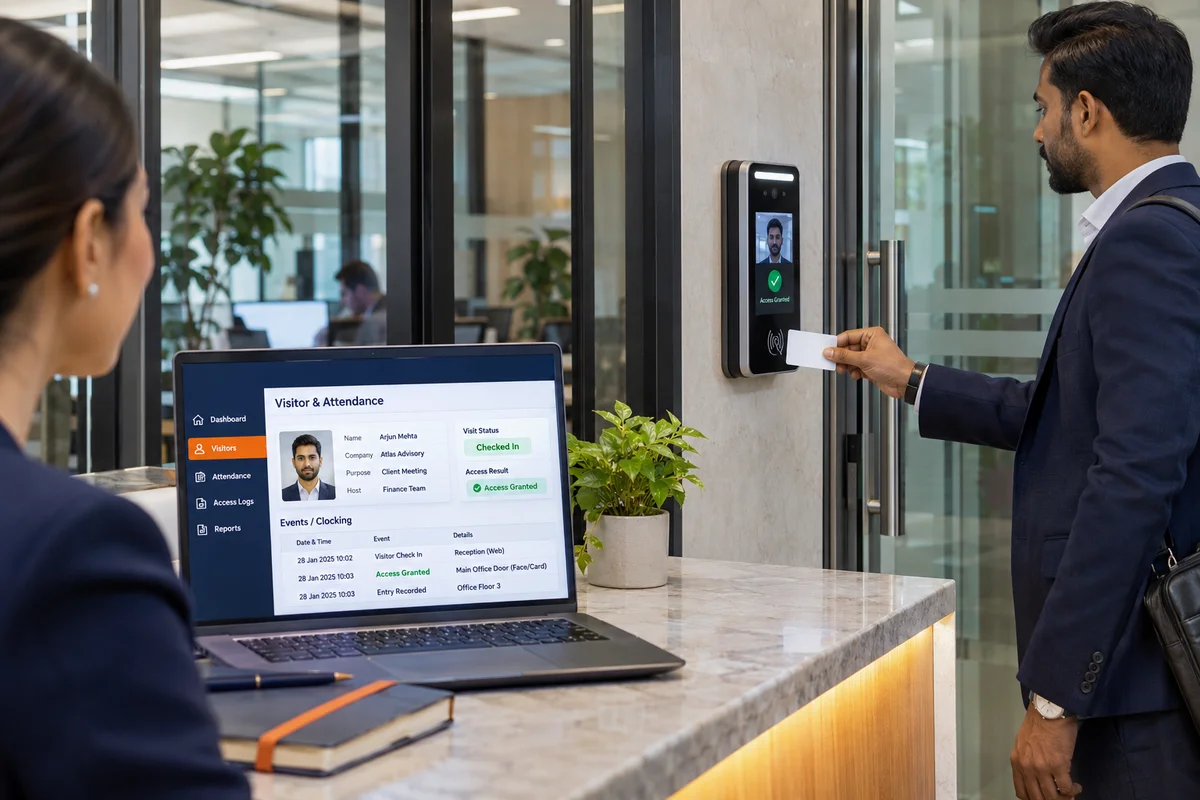
Connect the person, the record and the physical event.
A card read, a face match or a vehicle passage is only the start of a business workflow. The application needs to identify the person or owner, apply the organisation’s rules and show the right information to the people managing the site. We develop the software and device integrations that join those steps.
Where projects get stuck.
Attendance records do not reflect the organisation’s rules
Reader events alone do not explain how a record should be treated. We map attendance policies, clocking interpretation, colour-coded status indicators and reporting needs into the application.
The access team sees a passage without useful context
A vehicle event can be difficult to act on if owner information lives elsewhere. We connect the event with the relevant owner and vehicle data for the operational display.
Visitor and access records are managed separately
Reception or management staff may update one system while a device or another application uses different information. We define identifiers, responsibilities and the update path between them.
What we connect for people and site operations.
Attendance software and policy rules
Develop TAMS workflows around the agreed clocking rules, attendance exceptions and reports. Make status and colour indicators meaningful to the team using them.
Face readers and card/access systems
Integrate supported face readers, EntryPass or other agreed access interfaces. Establish how device events identify a person and enter the application workflow.
Visitor, owner and vehicle management
Build or connect the records needed by reception, property or access teams. Define how a visit or vehicle event relates to the relevant person or owner information.
Barrier and access-event displays
Connect the agreed passage events to operational views. Include missing-record, repeated-event and unavailable-device behaviour in the design and testing.
Attendance management needs to follow local operating rules rather than a generic report.
- Starting point
- A team receives clocking data from readers but has to interpret exceptions and prepare reports manually because the existing application does not reflect its working policies.
- Our approach
- We agree the rule definitions, link the reader/person identifiers and build the attendance views, colour-coded indicators and reports around those rules. Example and exception records are reviewed with the users.
- What improves
- The team can work from a defined interpretation of clocking data, with visible exceptions and reports tied to the agreed policy. The system’s behaviour is reviewable rather than hidden in manual adjustments.
Work that informs our approach.
For Kementerian Ekonomi, the workforce platform connects EntryPass and face readers with the ministry’s attendance rules, card colour indicators and reports. For TM Nxera, the access control platform centralises enrolment and tracks delivery across HID AMICO and AMAG Symmetry. We have also integrated owner and vehicle records with Vanderbilt passage events in separate visitor management work.
How we deliver the work.
- 01
Understand the people and rules
Review resident/owner, visitor or employee records and the actual entry, passage or attendance process.
- 02
Map devices to application records
Confirm reader/controller interfaces, identifiers, clocks, event timing and the system responsible for each record.
- 03
Build the operational application
Develop the required management screens, event displays, rules and reports with representative examples.
- 04
Validate on real scenarios
Test normal use, repeated reads, unmatched identities, offline devices and reporting exceptions with the delivery team.
What you receive.
- Record, rule and event-mapping design
- Management/attendance/visitor workflows within scope
- Reader, controller or barrier interfaces as agreed
- Validated exception cases and handover guidance
What helps us scope it.
- Reader, controller and platform models/versions
- Current person, owner or vehicle identifiers
- Approved attendance or site-access rules
- Examples of reports, exceptions and operator tasks
Questions about this service.
Can you work with our existing readers and controllers?
We review the actual device models, firmware, platform and supported integration route. Compatibility is established from those details and available access, rather than assumed from a brand name.
Can attendance rules be specific to our organisation?
Yes. The rules, exception treatment, colour indicators and reporting calculations are defined with your team and tested against representative cases before acceptance.
Is this the same as RMS?
They can relate to the same property operation, but the scopes differ. RMS is our resident-management web/mobile SaaS project; visitor, vehicle and access integration is assessed against the modules and deployment requirements you need.